Moti Ben-Ari
Introduction
For centuries people learned mathematics by studying Euclid’s Elements. A focus of the Elements is on the construction of geometric figures using a straightedge (a ruler with no markings) and a compass. The Elements gives constructions of regular polygons with  sides (and polygons with
  sides), but not until two thousand years later was the construction of another regular polygon discovered. In 1796 Carl Friedrich Gauss awoke one morning just before his 19th birthday, and by “concentrated thought” discovered that a regular heptadecagon (a regular polygon with 17 sides) is constructible.
In Euclidean geometry constructions are given as step-by-step instructions: starting with given points and lines, lines and circles are constructed and their points of intersection are used to construct new lines and circles. Gauss’s proof is revolutionary because he did not give any geometric constructions whatsoever. Instead, he defined constructibility as a property of expressions using integers and arithmetical operators, and then using algebra alone proved that the length of a side of a heptadecagon is given by an expression with the property required for constructibility. The algebra required is accessible with a knowledge of secondary-school mathematics.
Constructibility
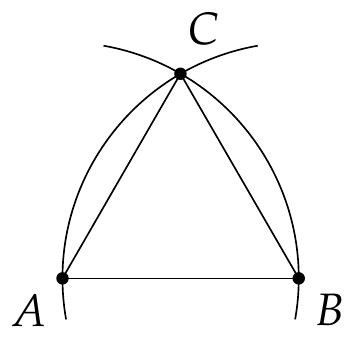
The first proposition in the Elements claims that an equilateral triangle can be constructed. (Henceforth, “construct” will be used as an abbreviation for “construct by straightedge and compass.”) Given a line segment  , draw two circles whose centers are
  and
and  , and whose radii are the length of .
  , the intersection of the circles, defines the third vertex of the triangle (Figure 1).
Definition: A real number  is constructible if and only if starting with a line segment defined to be of length 1 it is possible to construct a line segment of length .
Theorem: is constructible if and only if it is the result of evaluating an expression that uses only the integer 1 and the operations  .
.
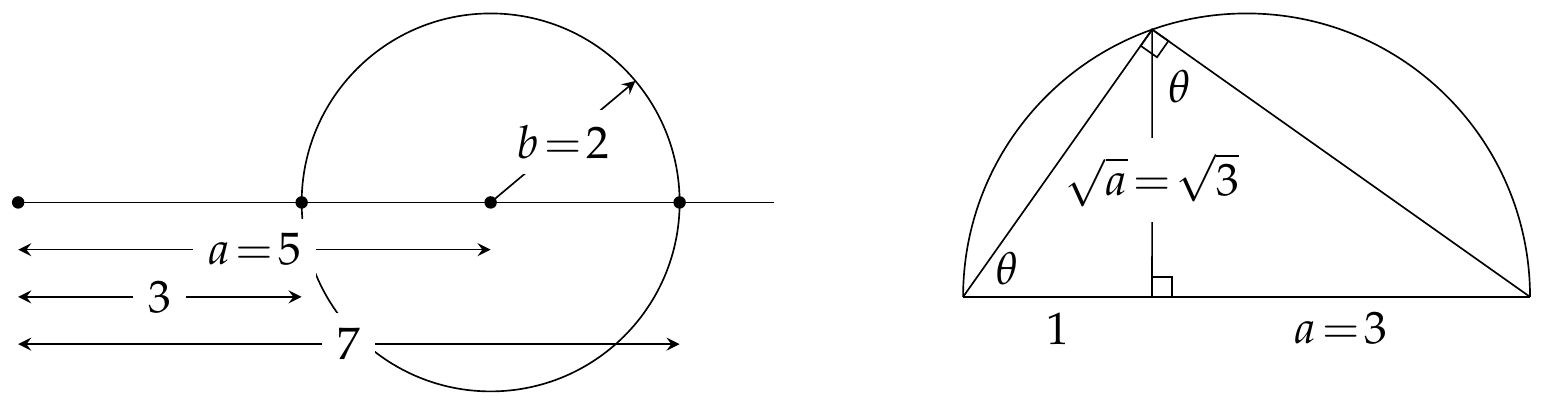
Examples: Figure 2 (left) shows how to construct  and
and  given
given  and
and  by constructing a circle of radius 2 whose center is an endpoint of
  . Figure 2 (right) shows how to construct
  given 1 and
  by constructing similar triangles within a semicircle.
 ,
, 
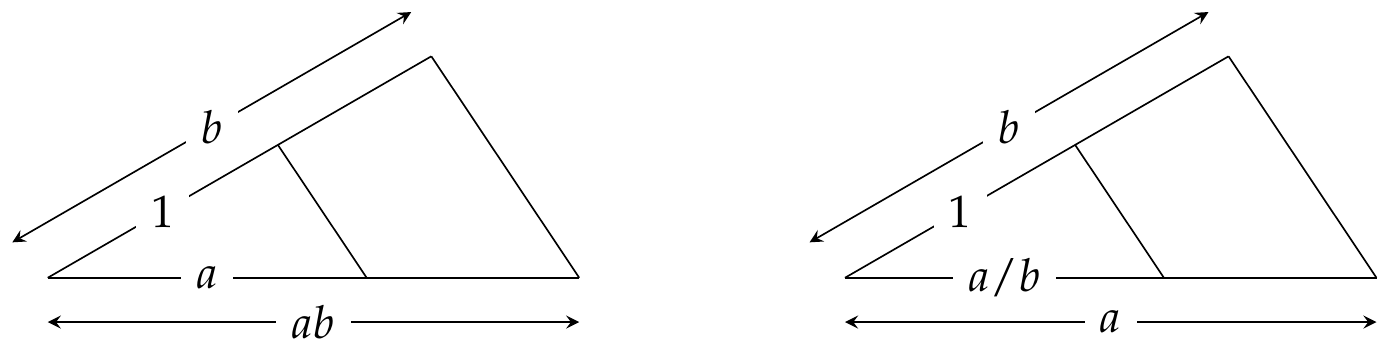
These constructions can be generalized to prove that an expression using  can be constructed. Expressions using
  can be constructed using similar triangles (Figure 3).

To prove the forward direction of the theorem, note that lines are defined by linear equations and circles by quadratic equations. By solving pairs of equations, it can be shown that the points of intersection of lines and circles are given by expressions using , as are the lengths of line segments which are the distances between two points.
Impossible constructions
The Greeks were unable to trisect an angle (divide a given angle into three equal parts), square a circle (construct a square with the same area as a given circle) and double a cube (construct a cube with twice the volume of a given cube). During the nineteenth century it was proved that these constructions are impossible.
Of equal interest was the construction of regular polygons. The Greeks were unable to construct regular polygons with  sides, but not until the work of Gauss was any progress made to determine if the construction of these polygons is possible or not.
The mathematics of constructibility
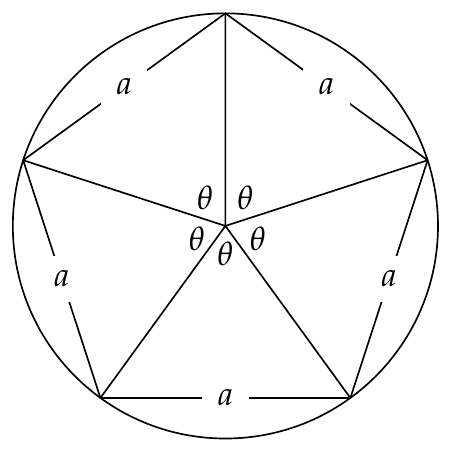
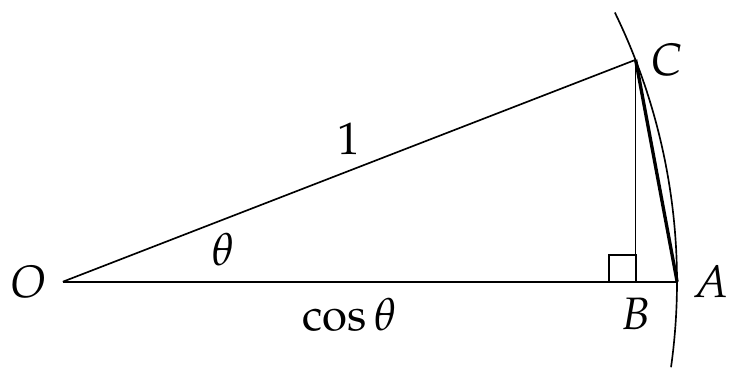
A regular polygon can be inscribed in a unit circle; all of its sides are equal and as are all of its central angles (Figure 4). Clearly, if we can construct a central angle we can construct the side of the polygon that subtends it. Construction has been defined only for line segments, so we first show that given a line segment of length  , where
  is the central angle of a regular polygon, the polygon is constructible.
Construct a unit circle centered at  and let be an arbitrary point on the circle. Construct the radius
  and construct the (given) line segment
  of length on . Construct the perpendicular at (Figure 5). By the definition of cosine, , the intersection of the perpendicular with the circle, defines the central angle and thus
  is a side of the polygon.
Let us look at some examples:
- The central angle of an equilateral triangle is
 and
and  is constructible, so the equilateral triangle is constructible.
 - The central angle of a regular pentagon is
 and it is not too hard to show that
  , so a regular pentagon is constructible.
 - The central angle of regular pentadecagon (a regular polygon with 15 sides) is
 . This can be constructed from an equilateral triangle (dashed blue) and regular pentagon (dashed red) with a common vertex and a common radius of a central angle (Figure 6).
  (red) is the central angle of the pentagon,
  (blue) is the central angle of the triangle and their difference is
  , which can be bisected to obtain
  .
.
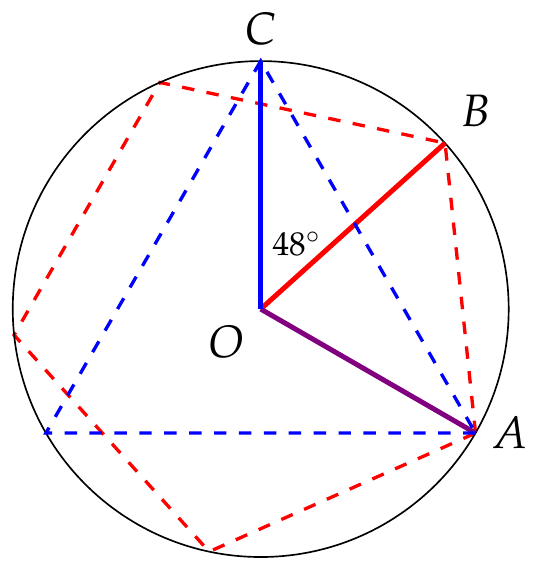
Figure 6: Central angles of an equilateral triangle and a pentagon Alternatively, trigonometric identities can be used to define
 from lengths previously shown to be constructible:
![\[\begin{aligned} \cos 48^\circ &= \cos(120^\circ - 72^\circ) = \cos 120^\circ \cos 72^\circ + \sin 120^\circ \sin 72^\circ \\ \cos 24^\circ &= \cos\frac{48^\circ}{2} = \sqrt{\frac{1 + \cos 48^\circ}{2}} \end{aligned}\]](https://blog.kleinproject.org/wp-content/ql-cache/quicklatex.com-b8e91f80d39421888cc4610c738e0711_l3.png "Rendered by QuickLaTeX.com")
Gauss’s goal was to show that  is constructible.
Mathematical prerequisites
With one exception we will only use mathematics usually taught in secondary school:
- Exponents:
 .
. - Integer division: given
 , there exist
  such that
  .
. - Quadratic polynomials: the roots of
 are
are  .
. - Trigonometric identities for
 .
. - Complex numbers: points on the unit circle can be represented as
 . de Moivre’s formula:
  .
.
The exception is the Fundamental Theorem of Algebra, which states that an  degree polynomial with complex coefficients has complex roots. Actually, we only need one simple case of the theorem: the polynomial
  has (at least) one root
  or, even more narrowly, that
  has (at least) one root
The roots of unity
The roots of are called the -th roots of unity. If  is an -th root of unity then
  so
so  is also an -th root of unity. It follows that
  are all -th roots of unity. What we don’t know is if they are distinct and thus all the -th roots of unity.
- The roots of the polynomial
 are
are  . By computation we find that
  , but
, but  , so the powers of
  are not distinct.
 - The roots of the polynomial
 are:
are:
![\[x_0 = 1, \quad x_1 = \frac{-1 + i\sqrt{3}}{2}, \quad x_2 = \frac{-1 - i\sqrt{3}}{2}\,.\]](https://blog.kleinproject.org/wp-content/ql-cache/quicklatex.com-9fac7f0978dff28cb6d8e08359fcb89a_l3.png "Rendered by QuickLaTeX.com")
By computation we find that
 and similarly
  , so the powers of the two roots (
 ) are distinct.
Theorem: If is a prime number and is an -the root of unity then  are distinct.
Proof: If  for some
  then
then  . Let
. Let  be the smallest positive integer such that
  . By the division formula:
![\[1 = r^n = r^{ml+k} = (r^m)^l \cdot r^k = 1^l \cdot r^k = r^k\,,\]](https://blog.kleinproject.org/wp-content/ql-cache/quicklatex.com-e10b41d0ce459d5e36b0e7218fe7ce3e_l3.png "Rendered by QuickLaTeX.com")
where  . But
. But  and
and  contradict the assumption that was the smallest such positive number, so
  and
and  is not prime.
From roots to coefficients of polynomials
Suppose that we know the values of  , two roots of a quadratic polynomial . What are the coefficients? By computation:
![\[(x - r_1)(x - r_2) = x^2 - (r_1 + r_2)x + r_1 r_2 = x^2 + bx + c\,,\]](https://blog.kleinproject.org/wp-content/ql-cache/quicklatex.com-611d783442b331d339bd72c0daeb0c71_l3.png "Rendered by QuickLaTeX.com")
so:
![\[b = -(r_1 + r_2), \qquad c = r_1 r_2\,. \qquad (1)\]](https://blog.kleinproject.org/wp-content/ql-cache/quicklatex.com-2049e23a27373019323f13f8f613ad33_l3.png "Rendered by QuickLaTeX.com")
Similarly the coefficients of any polynomial can be computed if the roots are known. Given that the roots of are  , we can find the coefficients of the polynomial by multiplying
  . The coefficient of
  is:
is:
![\[-(1 + r^1 + r^2 + \cdots + r^{15} + r^{16})\,,\]](https://blog.kleinproject.org/wp-content/ql-cache/quicklatex.com-1e9f06861197c9b8a6e77ed2d1cd9412_l3.png "Rendered by QuickLaTeX.com")
which is zero in so:
![\[r^1 + r^2 + \cdots + r^{15} + r^{16} = -1\,. \qquad (2)\]](https://blog.kleinproject.org/wp-content/ql-cache/quicklatex.com-373cb93098bfe221cb46809b5c151a20_l3.png "Rendered by QuickLaTeX.com")
Quadratic polynomials from the 17-th roots of unity
Gauss’s insight was that we need not work with the roots in their natural order  , but that other powers of roots can generate all the roots.
Is there a number  such that the sequence
  (all modulo 17) gives all the numbers in the sequence
  in a different order? Well, not all numbers work; for
  , we get only four distinct numbers:
![\[1,\ 4,\ 16,\ 64 = (17 \cdot 3 + 13) = 13,\ 256 = (17 \cdot 15) + 1 = 1\,.\]](https://blog.kleinproject.org/wp-content/ql-cache/quicklatex.com-741bcace7e8d77d818916d03a3cc10c4_l3.png "Rendered by QuickLaTeX.com")
However, for  , the sequence gives of all the numbers in the sequence in a different order:
![\[1,\ 3,\ 9,\ 10,\ 13,\ 5,\ 15,\ 11,\ 16,\ 14,\ 8,\ 7,\ 4,\ 12,\ 2,\ 6\,.\]](https://blog.kleinproject.org/wp-content/ql-cache/quicklatex.com-cabe39da75de5cff7f004b01e30dc63b_l3.png "Rendered by QuickLaTeX.com")
The reason is that 3 is relatively prime to 16 (and is, in fact, the smallest such integer).
Using as exponents we obtain a reordering of the powers of the root :
![\[r^1,\ r^3,\ r^9,\ r^{10},\ r^{13},\ r^5,\ r^{15},\ r^{11},\ r^{16},\ r^{14},\ r^8,\ r^7,\ r^4,\ r^{12},\ r^2,\ r^6\,.\]](https://blog.kleinproject.org/wp-content/ql-cache/quicklatex.com-dbfdc1da03948514a544299ff987792b_l3.png "Rendered by QuickLaTeX.com")
Write the sequence of roots as follows in order to distinguish roots in the odd positions from those in the even positions:
![\[\begin{array}{cccccccccccccccc} r^1 & & r^9 & & r^{13} & & r^{15} & & r^{16} & & r^8 & & r^4 & & r^2 & \\ & r^3 & & r^{10} & & r^5 & & r^{11} & & r^{14} & & r^7 & & r^{12} & & r^6\,. \end{array}\]](https://blog.kleinproject.org/wp-content/ql-cache/quicklatex.com-145bf4493e498edc79235f1b1eac0fa7_l3.png "Rendered by QuickLaTeX.com")
Let  be the sums of the roots in the odd and even positions, respectively:
![\[\begin{aligned} a_0 &= r + r^9 + r^{13} + r^{15} + r^{16} + r^8 + r^4 + r^2 \\ a_1 &= r^3 + r^{10} + r^5 + r^{11} + r^{14} + r^7 + r^{12} + r^6\,. \end{aligned}\]](https://blog.kleinproject.org/wp-content/ql-cache/quicklatex.com-549877e824ea4ed75d2a4c8aba731b4f_l3.png "Rendered by QuickLaTeX.com")
Compute  using Equation 2:
![\[a_0 + a_1 = r + r^2 + \cdots + r^{16} = -1\,.\]](https://blog.kleinproject.org/wp-content/ql-cache/quicklatex.com-76827d6ff505bbd8df5878ef3ab49163_l3.png "Rendered by QuickLaTeX.com")
Now compute  and simplify. It takes quite a lot of work [1, Section 16.4], but the result is the sum of four copies of Equation 2 so:
![\[a_0 a_1 = -4\,.\]](https://blog.kleinproject.org/wp-content/ql-cache/quicklatex.com-57ff502af772fd1cce1b19c54b8a0c5c_l3.png "Rendered by QuickLaTeX.com")
Given that are roots, by Equation 1 they are the roots of the polynomial:
![\[y^2 + y - 4 = 0\,,\]](https://blog.kleinproject.org/wp-content/ql-cache/quicklatex.com-3fd644d003be733ed926736c2a16a806_l3.png "Rendered by QuickLaTeX.com")
and their values are:
![\[a_0, a_1 = \frac{-1 \pm \sqrt{17}}{2}\,.\]](https://blog.kleinproject.org/wp-content/ql-cache/quicklatex.com-da35eaf9bb5bd926cf3966bd9ecec7a4_l3.png "Rendered by QuickLaTeX.com")
Let  be the sums of every fourth root starting from
  , respectively:
![\[\begin{aligned} b_0 &= r^1 + r^{13} + r^{16} + r^4 \\ b_1 &= r^3 + r^5 + r^{14} + r^{12} \\ b_2 &= r^9 + r^{15} + r^8 + r^2 \\ b_3 &= r^{10} + r^{11} + r^7 + r^6\,. \end{aligned}\]](https://blog.kleinproject.org/wp-content/ql-cache/quicklatex.com-c70c85ba3beb30266681a89944c70c3c_l3.png "Rendered by QuickLaTeX.com")
Check that  and compute the corresponding products which are
  . Therefore,
  are the solutions of
  , and
, and  are the solutions of
  . Using the values previously computed for we can compute the roots
  . The results are:
![\[b_0, b_1 = \frac{(-1 \pm \sqrt{17}) + \sqrt{34 \mp 2\sqrt{17}}}{4}\,.\]](https://blog.kleinproject.org/wp-content/ql-cache/quicklatex.com-0e550e6362aa4c947395027bd74a28e9_l3.png "Rendered by QuickLaTeX.com")
(For  take plus and then minus and for
  take minus and then plus.)
Finally, let  be the sums of every eighth root starting with
  , respectively:
![\[\begin{aligned} c_0 &= r^1 + r^{16} \\ c_4 &= r^{13} + r^4 \\ c_0 + c_4 &= b_0 \\ c_0 c_4 &= b_1\,. \end{aligned}\]](https://blog.kleinproject.org/wp-content/ql-cache/quicklatex.com-18b72e9e6fc80f36c2e1251ba6747b25_l3.png "Rendered by QuickLaTeX.com")
are the roots of  :
:
![\[c_0, c_4 = \frac{b_0 \pm \sqrt{(-b_0)^2 - 4b_1}}{2}\,,\]](https://blog.kleinproject.org/wp-content/ql-cache/quicklatex.com-f3538d0a7b4777360cbb7814b19fde7f_l3.png "Rendered by QuickLaTeX.com")
which after a lot of messy algebra reduces to:
![\[\begin{aligned} c_0 = &-\frac{1}{8} + \frac{1}{8}\sqrt{17} + \frac{1}{8}\sqrt{34 - 2\sqrt{17}}\ + \\ &\frac{1}{8}\sqrt{68 + 12\sqrt{17} + 2(-1 + \sqrt{17})\sqrt{34 - 2\sqrt{17}} - 16\sqrt{34 + 2\sqrt{17}}}\,. \end{aligned}\]](https://blog.kleinproject.org/wp-content/ql-cache/quicklatex.com-0d7ff4d0d852280e950fec17c4da4468_l3.png "Rendered by QuickLaTeX.com")
What do these solutions of quadratic equations whose coefficients are derived from the roots of have to do with the heptadecagon?
Connecting the quadratic expression to the heptadecagon
Actually, we know an expression for a root of , although the expression does not show that the value is constructible:
![\[r = \cos\frac{2\pi}{17} + i\sin\frac{2\pi}{17}\,.\]](https://blog.kleinproject.org/wp-content/ql-cache/quicklatex.com-d9229e46f9c9600163041dca57a544b3_l3.png "Rendered by QuickLaTeX.com")
This follows from de Moivre’s formula:
![\[r^{17} = \left(\cos\frac{2\pi}{17} + i\sin\frac{2\pi}{17}\right)^{17} = \cos 2\pi + i\sin 2\pi = 1\,.\]](https://blog.kleinproject.org/wp-content/ql-cache/quicklatex.com-83af1b4e5ea2411d21ce973d0a980b65_l3.png "Rendered by QuickLaTeX.com")
We found a constructible expression for  so let’s see where this leads us:
![\[r^1 + r^{16} = \left(\cos\frac{2\pi}{17} + i\sin\frac{2\pi}{17}\right) + \left(\cos\frac{16 \cdot 2\pi}{17} + i\sin\frac{16 \cdot 2\pi}{17}\right) = 2\cos\frac{2\pi}{17}\,,\]](https://blog.kleinproject.org/wp-content/ql-cache/quicklatex.com-63826771fb11f89ee51bb70a3ee57994_l3.png "Rendered by QuickLaTeX.com")
since:
![\[\cos\frac{16 \cdot 2\pi}{17} = \cos\left(\frac{34\pi}{17} - \frac{2\pi}{17}\right) = \cos 2\pi \cos\frac{2\pi}{17} - \sin 2\pi \sin\frac{2\pi}{17} = \cos\frac{2\pi}{17}\,,\]](https://blog.kleinproject.org/wp-content/ql-cache/quicklatex.com-408716b8c59f96e722b7b31198545562_l3.png "Rendered by QuickLaTeX.com")
and similarly  . It follows that:
![\[\frac{c_0}{2} = \frac{r^1 + r^{16}}{2} = \cos\frac{2\pi}{17}\,.\]](https://blog.kleinproject.org/wp-content/ql-cache/quicklatex.com-d00ff18d4cd00bcea57c9aa8e9d4994e_l3.png "Rendered by QuickLaTeX.com")
Therefore, the cosine of the central angle of a heptadecagon is the result of evaluating an expression that uses only the integer 1 and the operations , so a regular heptadecagon is constructible using a straightedge and compass!
The formula that usually appears in the literature is:
![\[\begin{aligned} \cos\frac{2\pi}{17} = &-\frac{1}{16} + \frac{1}{16}\sqrt{17} + \frac{1}{16}\sqrt{34 - 2\sqrt{17}} \\ &+ \frac{1}{8}\sqrt{17 + 3\sqrt{17} - \sqrt{34 - 2\sqrt{17}} - 2\sqrt{34 + 2\sqrt{17}}}\,. \end{aligned}\]](https://blog.kleinproject.org/wp-content/ql-cache/quicklatex.com-1c5b047d17ec2890653eadb1b85fcf2c_l3.png "Rendered by QuickLaTeX.com")
We leave it to the reader to derive this formula from the one we derived above.
Gauss-Wantzel Theorem
Theorem: A regular polygon with sides is constructible if and only if is the product of a power of 2 and zero or more distinct Fermat numbers  which are prime.
Gauss proved that the condition for constructibility is sufficient and Pierre Laurent Wantzel proved that the condition is necessary.
The known Fermat primes are:
![\[F_0 = 3, \quad F_1 = 5, \quad F_2 = 17, \quad F_3 = 257, \quad F_4 = 65537\,,\]](https://blog.kleinproject.org/wp-content/ql-cache/quicklatex.com-62fd05cb30b4002c7d8f6c179e73f6a6_l3.png "Rendered by QuickLaTeX.com")
and it has been proven that  are not prime.
The equilateral triangle is constructible by  , the regular polygon by
  , the regular heptadecagon by
  . The Greeks were also able to construct the regular pentadecagon which is constructible by
  . By the theorem the regular polygons with
  ,
,  and
and  sides are constructible.
A regular polygon with  sides was constructed by Magnus Georg Paucker in 1822 and by Friedrich Julius Richelot 1832. In 1894 Johann Gustav Hermes claimed to have constructed a regular polygon with
  sides.
Conclusion
Until the late eighteenth century mathematical theorems were proved geometrically. Even Newton who invented the calculus used it as a means of discovery always proved theorems using geometry. Gauss proved the constructibility of the heptadecagon without giving a geometric construction. In fact, the first constructions were not published until almost a century later (a modern construction is given in [3]). His algebraic solution led to the growing ascendancy of algebra during the nineteenth century and to the birth of fields of modern mathematics like algebraic geometry and algebraic topology.
Acknowledgment
I would like to thank Samuel Bengmark for his comments that helped significantly improve the vignette.
References
- Mordechai Ben-Ari. Mathematical Surprises. Springer, 2020. Open access from: https://link.springer.com/book/10.1007/978-3-031-13566-8.
- Jörg Bewersdorff. Galois Theory for Beginners: A Historical Perspective (Second Edition). American Mathematical Society, 2019.
- James J. Callagy. The central angle of the regular 17-gon. The Mathematical Gazette, 67(442):290–292, 1983. https://www.jstor.org/stable/3617271.
Mordechai (Moti) Ben-Ari is Prof. (Emeritus) at the Weizmann Institute of Science and the author of the book “Mathematical Surprises”, Springer. https://www.weizmann.ac.il/sci-tea/benari/